
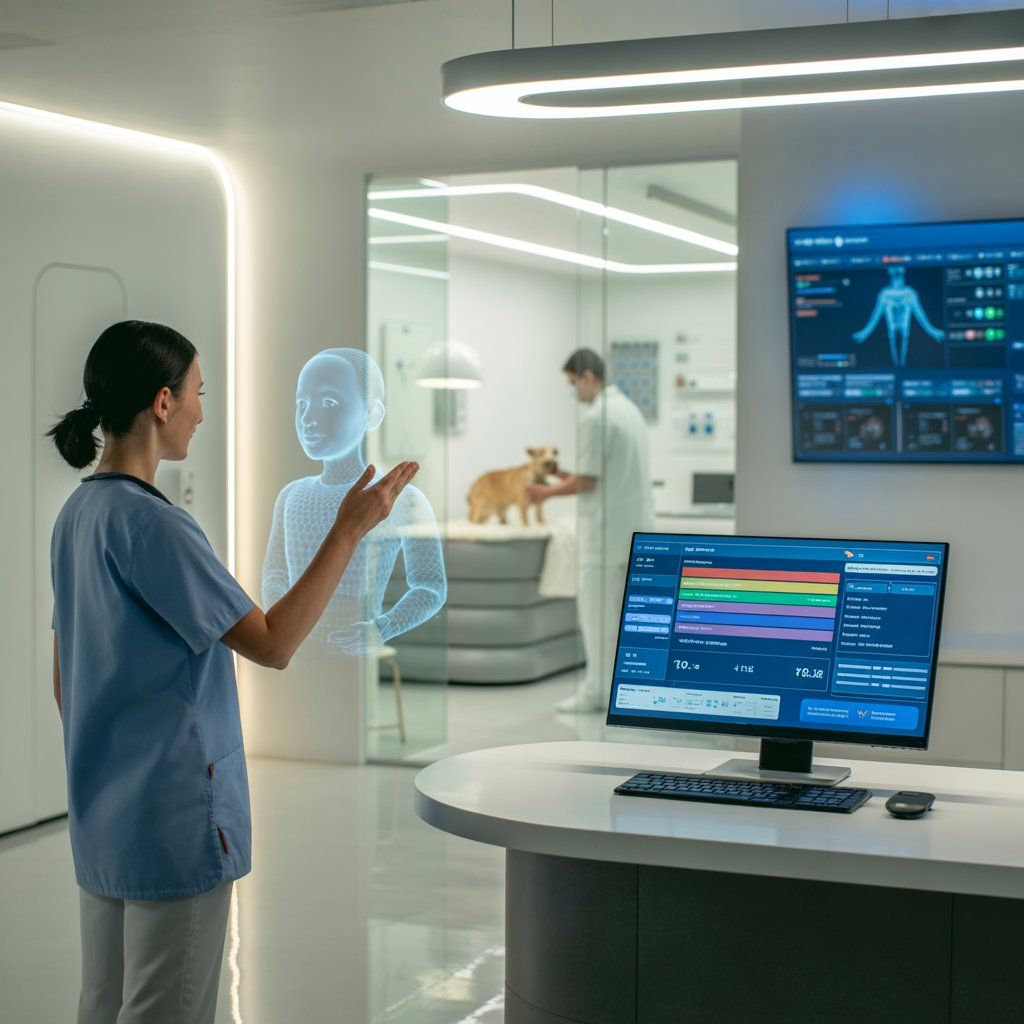
For the past 20 years, Epic and Cerner have dominated the health technology market as widely used EHR systems. They establish trust in hospitals, major medical facilities, and outpatient departments by managing all aspects of patient records, appointments, billing, and regulatory compliance.
Their power stems from being a horizontal system that covers virtually everything, from clinical documentation to administrative work. However, the healthcare technology sector is rapidly shifting.
The professionalism and rapid customization of industry-specific AI-powered software are among the most profound trends in healthcare. The leading sectors are dentistry, optometry, and veterinary medicine.
These targeted programs are, at the same time, the fastest and most efficient, not only addressing the very issues that large EHRs typically overlook but also surpassing them in other respects.
The Era of “One-Size-Fits-All” EHRs
Large electronic health records (EHRs) gained wide acceptance largely because they were marketed to be able to meet all users' needs. Hospital administrators could manage large numbers of patients, comply with complex legal requirements, and monitor revenue and expenditures within a single system.
However, the integration of everything, which is referred to as the all-in-one approach, has its setbacks:
- Innovation is slow: New features may take several months or even years to become available.
- Users' process complexities: Medical staff have to navigate numerous displays and options just to accomplish their everyday job.
- High costs: Customization is possible, but often expensive.
- Generic design: Large EHRs are designed to serve multiple specialties, resulting in partial optimization of niche workflows.
Such systems are appropriate for universal hospitals and large healthcare groups. However, what about specific areas, such as orthodontics, ophthalmology, or veterinary care? The "one-size-fits-all" approach generally slows the workflow and frustrates physicians in these cases.
The Conflict: When Big Box EHRs Fail Specialized AI Practices
Specialized fields have workflows that differ significantly from general medicine. Let’s break it down:
- Dentistry: Dental clinics require advanced imaging integration, procedure tracking, and insurance coordination. Large EHRs may manage patient records, but often fail to streamline dental imaging or efficiently track cavities.
- Optometry: Optometrists perform eye examinations, master the art of lenses, write prescriptions, and manage standard imaging data that standard EHRs cannot fully handle. Thus, they require software that prioritizes vision-specific workflows.
- Veterinary Medicine: Animal patients come from various species, have different levels of toughness, and vary in size. A regular EHR for humans cannot simply determine the dose for a Chihuahua as compared to a Great Dane, nor can it monitor treatments specific to the species.
In such scenarios, large EHRs can still function but cannot enhance workflow, thereby slowing clinics, increasing administrative costs, and reducing staff time spent with patients.
The Rise of Niche AI EHRs
In response to the demands of specialized areas, new EHR systems are taking shape. These highly specialized EHRs are designed for a particular sector and are often centered on AI-based, mobile-first, and voice-first processes.
The main characteristics of these niche AI systems are:
- Voice-first documentation: Through dictation, faster note-taking is enabled while typing errors are reduced; thus, it is a time-saving process for clinicians.
- Mobile accessibility: Patients' information is available on tablets and phones at all times, covering from doctors' offices to telemedicine consultations.
- Industry-specific AI: The AI is familiar with the specific characteristics of a field and is thus able to provide very supportive actions through suggestions, calculation of dosages, and recommendations on treatment.
- Rapid updates: EHRs for narrow markets can add new features and even modify the system to accommodate new workflows, in contrast to the case of slow, large-scale systems.
For example, an AI-powered veterinary documentation solution may automatically suggest treatment plans based on the animal's species, breed, age, and medical history. Conversely, the dentist's AI evaluates imaging and medical history to identify patients at high risk.
In optometry, AI may help identify trends in vision changes and support proactive follow-up scheduling.
These features are not “nice-to-haves.” They are critical for efficiency, accuracy, and patient safety in specialized practices.
Human vs. Animal Workflows
For example, the gap between human and animal workflows is so vast that comparing common EHR systems in nursing to veterinary software reveals entirely different tech stacks, with the latter now leading the charge in generative AI.
This illustrates why specialization matters. A common EHR system may cover the basics, but AI-powered niche software can go deeper, offering automation and insights tailored to the specific workflow.
Comparison Table: Big Box vs Vertical SaaS
Here’s a simple comparison to highlight the differences:
As this table shows, vertical SaaS EHRs are not just catching up; they are often ahead in usability, speed, and functionality.
Why Niche AI EHRs Are Winning
Several factors explain why niche AI EHRs are gaining ground:
- Better User Experience: Clinicians spend less time navigating complex systems and more time caring for patients.
- Faster Adoption: Mobile-first, voice-first tools are easier to learn, reducing training time.
- Smarter AI: Industry-specific AI can suggest treatments, flag risks, and streamline billing.
- Cost Efficiency: Tailored solutions reduce overhead costs and IT burden.
- Innovation-Friendly: Smaller, vertical software companies can implement AI and workflow improvements faster than massive EHR providers.
In short, niche systems fit the workflow, rather than forcing clinicians to adapt to software.
Real-World Impact on Veterinary Clinics
Veterinary practices highlight the power of niche AI EHRs. A single clinic may treat dogs, cats, birds, and reptiles, each with different care protocols. Traditional human EHRs cannot handle this complexity.
An AI-powered veterinary documentation tool can:
- Auto-fill patient histories for different species
- Suggest species-specific treatments
- Calculate precise dosages
- Integrate imaging and lab results
This reduces human error, improves patient care, and frees up staff to focus on more meaningful tasks.
Industry Adoption and Growth
The trend toward specialized AI EHRs is accelerating:
- Dentistry: Cloud-based dental EHRs with AI-assisted imaging have seen adoption rates increase by more than 40% in recent years.
- Veterinary medicine: Practices adopting AI-driven micro-EHRs report a 20–30% reduction in documentation time.
- Optometry: Clinics are increasingly relying on AI-assisted visual records and predictive analytics for patient management.
These numbers show that specialization isn’t just a buzzword; it’s a measurable improvement in workflow efficiency, accuracy, and user satisfaction.
The Future of EHRs
The future is clear: specialization plus AI is the new standard. Large, general EHRs will continue to serve major hospitals, but vertical SaaS solutions are increasingly prevalent in specialized fields.
We are moving toward a world where:
- Dental clinics rely on AI-driven imaging and patient management software.
- Veterinary practices leverage voice-first, generative AI for documentation.
- Optometry clinics use niche EHRs that seamlessly integrate imaging, billing, and follow-ups.
Micro-EHRs are faster, smarter, and more relevant for specific industries. And AI ensures they continue to improve at a pace that big-box systems cannot match.
Conclusion
Over the last two decades, the healthcare market has been primarily ruled by vast EHRs. Nevertheless, the uniformity of such overlimiting is now a barrier for them. Grounded in AI, specialized EHRs attest to their ability to enable faster adoption, smoother integration with workflows, and more insightful insights.
The adoption of AI in dentistry, optometry, and veterinary medicine is evident. While generic systems struggle, these institutions already use specialized tools.
The main point is simple: either you opt for specialization and AI-powered EHRs, or you risk extinction.